The construction equipment rental market entered 2026 on a strong footing. After several years of rising infrastructure investment, shifting contractor preferences, and digital disruption in equipment sourcing, the rental segment is consolidating its role as an asset-light, flexible solution for builders and developers worldwide. This analysis looks at the market size and growth outlook for 2026, the main demand drivers, technology and operational trends, the India-specific picture, and what platforms such as Equipments Dekho are doing to capture the opportunity.
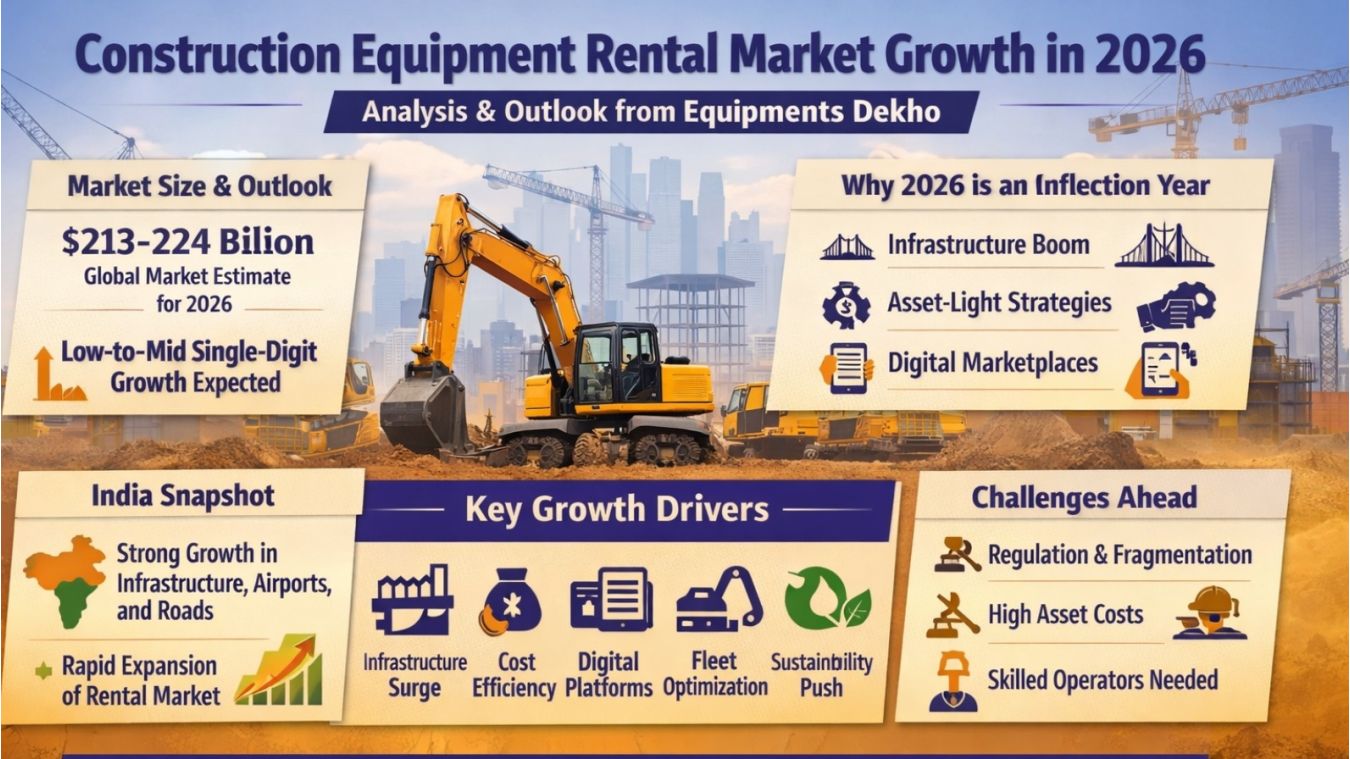
Multiple industry reports point to steady growth for the global rental market in 2026. Large market-research houses estimate that the market is expanding from 2025 into 2026 across a range of base values — reflecting differences in scope and methodology — but the consensus is clear: low-to-mid single-digit to mid-single-digit growth into 2026 and healthy multi-year CAGR thereafter. For example, a recent Grand View Research report estimated the global construction equipment rental market at roughly USD 213–224 billion range for 2025–2026 and projects ongoing expansion. Fortune Business Insights and other analysts show a similar multi-year growth trajectory and point to a robust pipeline of construction and infrastructure demand as foundational to the market’s expansion.
(Using several sources gives a fuller picture because published market totals vary with definitions — some include ancillary services and used-equipment flows while others focus strictly on rental revenue.)
Three structural forces make 2026 particularly notable:
Infrastructure acceleration and government spending — Renewed commitments to roads, airports, urban transit, and industrial projects in multiple regions are driving equipment needs that favor rental for speed and flexibility. Industry reporting from late-2025 into early-2026 highlights renewed project starts in several markets.
Operator preference for asset-light models — Contractors increasingly prefer renting to avoid the capital burden, maintenance risk, and idle-asset cost. Rental lets firms scale capacity by project and preserve working capital, a behaviour noted across Indian and global studies.
Digital marketplaces and logistics efficiency — Platforms that match demand and supply with transparent pricing, verified listings, and logistics coordination are reducing friction and expanding the rental customer base. This trend is accelerating substitution of ownership with short- to medium-term rental arrangements.
India is one of the faster-growing regional markets. Recent India-focused reports estimate the domestic rental market growing strongly in 2026, with market-size estimates around the low-to-mid-double-digit billion-dollar range and multi-percent CAGRs over the coming 5–7 years. Analysts point to government programs (National Infrastructure Pipeline, PM Gati Shakti), rural and urban road projects, airport expansion, and renewed private-sector capex as primary demand drivers. Local research projects Indian market expansion as contractors shift to rentals and used-equipment purchases for cost efficiency.
Equipments Dekho — as an India-based marketplace — sits at the center of this transition by providing a local, trusted channel for renting, buying used equipment, and coordinating logistics. Its recent content and rental listings reflect the broader industry movement toward online sourcing and flexible fleet strategies.
Despite promising growth, the rental market faces challenges that shape near-term expansion:
Equipments Dekho’s marketplace model addresses multiple friction points: verified listings, integrated rental and used-equipment flows, transparent pricing, and content resources that help contractors decide whether to rent or buy. In 2026, platforms that combine marketplace liquidity with logistics and operator services will be better positioned to capture growing booking volumes — a role Equipments Dekho is actively playing in India.
Q: How big is the global construction equipment rental market in 2026?
Estimates vary by source and scope, but recent industry reports place 2026 market value in the low-hundreds of billions USD range (different methodologies produce different totals). Major research houses report steady growth from 2025 into 2026.
Q: What is driving rental growth in India specifically?
India’s growth is driven by infrastructure programs (NIP, airport and road projects), contractor preference for asset-light models, and expanding digital rental platforms that simplify sourcing.
Q: Are digital marketplaces important for 2026 growth?
Yes. Marketplaces lower transaction friction, improve transparency, and enable logistics coordination and operator services that make rentals more attractive vs ownership.
Q: Should contractors rent or buy in 2026?
It depends on project horizon: rent for short-term or variable workloads; consider buying (new or used) for long-term, steady utilization. Hybrid models are increasingly common.
Q: How can Equipments Dekho help contractors in 2026?
Equipments Dekho provides a marketplace to find, compare, and book rental equipment, access used-equipment listings, and read practical guides — helping contractors make faster, lower-risk procurement decisions.
2026 is shaping up to be another constructive year for the equipment rental market: steady demand from infrastructure, increasing digital adoption, and shifting contractor economics favor rental models. For India, platforms like Equipments Dekho are practical enablers of that transition — matching supply to project demand while reducing transactional friction. If you’d like, I can prepare a one-page infographic or a downloadable brief summarizing the 2026 numbers and strategic recommendations for contractors and rental operators.
Meena Iyer is a construction site manager with more than 12 years of experience in infrastructure and commercial projects. She specializes in equipment planning, rentals, and maintenance scheduling. Through her blogs at Equipments Dekho, Meena shares practical advice and project-tested insights that help contractors save time and money.


Comments