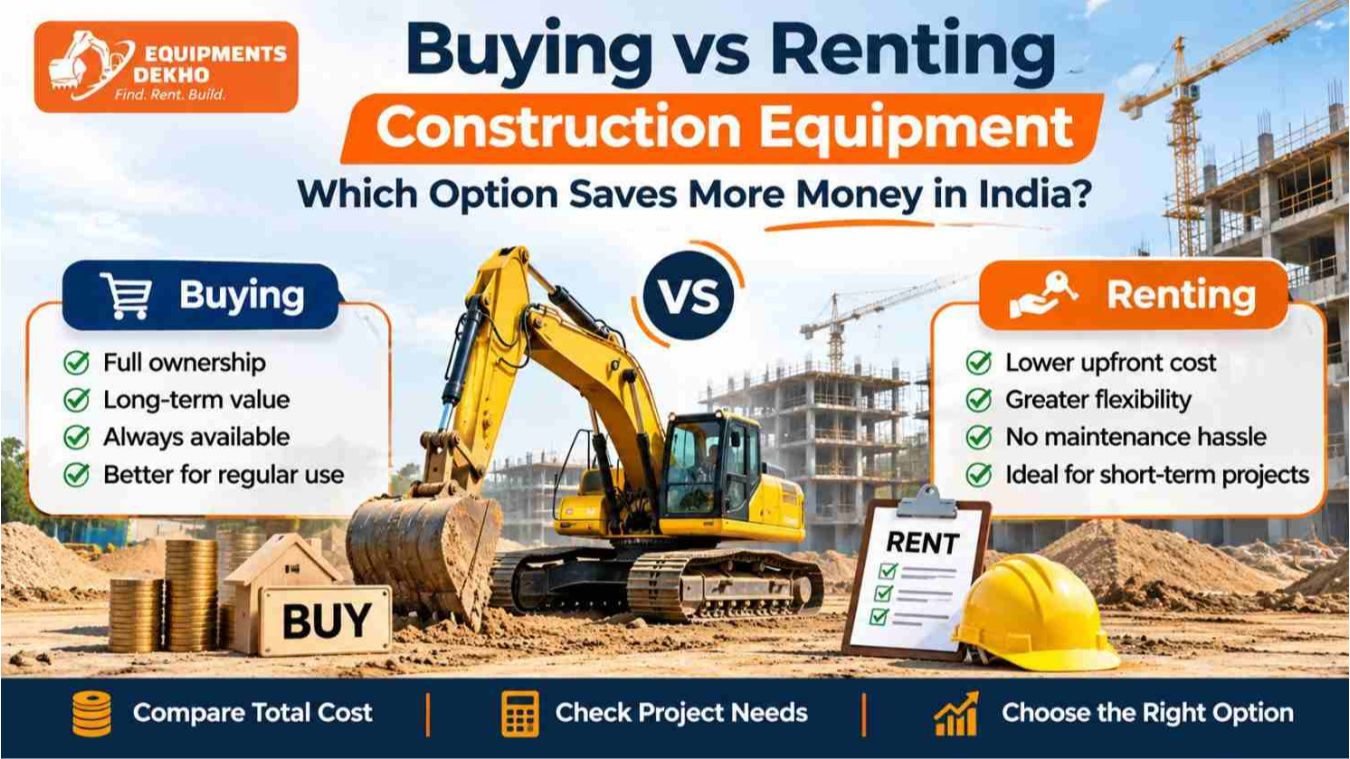
Choosing between buying and renting construction equipment is an important financial decision for contractors, builders and construction companies. The right choice can help you control project costs, complete work on time and improve your profit margins. However, the wrong decision can increase expenses and create problems with equipment maintenance, storage and financing.
Some contractors prefer buying heavy machinery because it gives them complete control and long-term access. Others choose construction equipment rental because it reduces the initial investment and provides more flexibility.
But which option actually saves more money?
The answer depends on your project duration, equipment usage, budget and future work requirements. In this guide, we will compare buying vs renting construction equipment, explain the hidden costs of machine ownership, discuss rental benefits and help you decide which option is better for your business in India.
Before making a decision, understand the major differences between purchasing and renting heavy machinery.
Quick Answer: Renting construction equipment is generally more economical for short-term projects and occasional machine use. Buying can save more money when a machine is required regularly for several years and its total ownership cost is lower than the cost of renting it for the same period.
Buying construction equipment may look like a good investment, especially when your company handles multiple projects throughout the year. You pay for the machine and can use it whenever required.
However, the purchase price is only one part of the total cost.
When calculating the heavy machinery ownership cost, contractors should consider several additional expenses.
1. Initial Purchase Price
Construction equipment such as excavators, JCB machines, loaders, cranes and road rollers can require a significant investment. The purchase price depends on the brand, model, capacity, features and machine condition.
For new machines, the initial investment can be particularly high.
2. Loan Interest and Financing Costs
If you purchase equipment through a business loan or machinery financing, interest payments increase the overall investment.
You also need to consider processing fees, down payments and monthly instalments.
3. Maintenance and Repairs
Heavy machinery requires regular servicing to maintain performance.
Common expenses include:
Unexpected breakdowns can also increase repair costs and delay project work.
4. Insurance and Registration
Depending on the equipment and its usage, owners may need to pay for insurance, registration and other applicable compliance requirements.
These costs should be included in the ownership budget.
5. Storage and Transportation
Owned machines need a suitable place for parking and storage when they are not being used.
Moving heavy equipment between construction sites can also increase transportation expenses.
6. Depreciation
Construction equipment loses value over time because of regular use, ageing and technological changes.
For example, an excavator purchased today may have a lower resale value after several years of operation.
This reduction in value is an important part of the total ownership cost.
Buying equipment can be a good decision when:
For contractors working on highways, commercial buildings, mining projects and large infrastructure developments, owning frequently used machinery can provide better long-term control.
Construction equipment rental allows contractors to use machinery for a specific period without purchasing it.
Instead of investing a large amount in buying a machine, you pay according to the agreed rental period.
This can be particularly useful for businesses handling short-term projects or working with limited budgets.
Although renting reduces the initial investment, it is important to understand the complete rental expense.
1. Daily, Weekly or Monthly Rental Charges
Rental prices depend on the machine type, model, capacity, rental duration and location.
For example, the rental cost of an excavator may differ from that of a JCB backhoe loader or wheel loader.
2. Transportation Charges
Heavy machinery may need to be transported from the equipment owner's location to your construction site.
Transportation charges depend on distance, machine size and logistics arrangements.
3. Fuel and Operator Expenses
Some rental agreements include an operator and fuel, while others require the contractor to arrange them separately.
Always confirm these details before finalising the agreement.
4. Security Deposit
Some equipment providers ask for a refundable security deposit before handing over the machine.
The amount and refund conditions should be clearly mentioned in the rental agreement.
5. Extra Usage Charges
If the equipment is rented for a fixed number of hours or shifts, additional usage may attract extra charges.
Contractors should check the working-hour limits and overtime terms before booking.
Rental services help contractors access heavy machinery without blocking a large amount of capital.
For example, a contractor working on a three-month road construction project may need a road roller, excavator and motor grader for different stages of work.
Instead of purchasing all three machines, the contractor can rent them according to the project schedule.
This makes budgeting easier and reduces the risk of keeping expensive equipment unused after project completion.
Let's understand the financial difference through a simple example.
Imagine a contractor needs an excavator for a construction project lasting four months.
The following figures are hypothetical and are used only to explain the calculation. Actual prices will depend on the machine model, location, rental agreement and market conditions.
In this example, renting costs approximately ₹7.5 lakh for the project, while purchasing requires a much larger initial investment.
However, the buying calculation does not subtract the machine's resale value after the project. The machine remains an asset that can be used for future projects or sold later.
Similarly, the rental calculation assumes that the stated rental charge covers the required four-month period and excludes any additional fuel, operator or overtime expenses not included in the agreement.
What does this comparison tell us?
For a four-month project, renting may be the more practical financial choice because the contractor avoids a large upfront investment.
However, if the same excavator is required continuously for several years, buying may become more economical.
The important point is to compare the total cost of ownership with the total rental cost over the same period.
Construction equipment rental is becoming an important option for contractors who want flexibility and better control over project expenses.
Here are five major benefits.
Buying heavy machinery can require a large amount of capital.
Renting allows contractors to use the required equipment without spending lakhs of rupees on purchasing a machine.
This money can be used for labour, materials, transportation and other project expenses.
Every construction project has different machinery requirements.
For example:
Renting allows contractors to select different machines according to their project requirements.
When equipment is rented, certain maintenance responsibilities may be handled by the equipment provider.
This depends on the rental agreement.
Before hiring, confirm who is responsible for routine servicing, breakdown repairs, replacement machinery and maintenance-related downtime.
A major benefit of renting is that businesses do not need to invest heavily in machinery.
Contractors can keep more working capital available for daily operations and unexpected project expenses.
This is particularly useful for small businesses and contractors handling multiple projects.
A contractor may need an excavator for one project and a crane for another.
Buying every machine can be expensive.
Rental services allow businesses to arrange machinery according to project duration, site conditions and work requirements.
Many contractors calculate the purchase price but overlook the additional expenses associated with owning construction equipment.
These hidden costs can affect profitability.
Here are five expenses you should consider before purchasing heavy machinery.
For example, a contractor who purchases a wheel loader for one project may struggle to recover the investment if the machine remains unused for several months.
This is why calculating the complete ownership cost is essential before purchasing equipment.
Buying is not always an expensive mistake. In the right situation, it can be a smart long-term business investment.
Consider purchasing machinery if the following conditions apply.
If your business has a steady flow of construction projects, owning frequently used machinery can reduce repeated rental expenses.
Businesses that use excavators, loaders or backhoe loaders regularly may benefit from having their own machines.
Ownership gives you greater control over machine availability, usage schedules and equipment modifications, subject to applicable requirements.
If you have skilled operators, mechanics and suitable maintenance facilities, managing owned equipment can become easier.
Large contractors and construction companies may purchase machinery to develop their own equipment fleet and support multiple projects.
Practical Tip: Before purchasing, estimate the machine's annual working hours. A machine that works regularly may justify its purchase price, while equipment used for only a few weeks each year may be better rented.
Renting is often a better option when machinery requirements are temporary or uncertain.
Consider renting in these situations.
If you need a machine for a few days, weeks or months, renting can help avoid unnecessary investment.
New contractors may not have enough capital to purchase expensive machinery.
Rental services allow them to take projects without purchasing an entire equipment fleet.
Some construction businesses experience higher demand during specific months.
Renting helps arrange additional machinery when workload increases.
Certain projects require specialised equipment that may not be needed again.
Renting can provide access to the required machine without long-term ownership costs.
If you are planning to purchase a particular machine model, renting a similar machine first may help you understand its performance, productivity and suitability for your work.
This can reduce the risk of making an unsuitable purchase.
Different machines have different usage patterns. Your decision should depend on the type of equipment and how frequently your projects require it.
These are general recommendations, not fixed rules. A large contractor may find it economical to own a crane, while a small contractor may benefit from renting one.
The right decision depends on machine utilisation, rental rates, maintenance expenses and the expected life of the equipment.
Before making your final decision, calculate the total cost of both options.
A simple comparison can help you understand which option is financially better.
Total Ownership Cost = Purchase Price + Financing Cost + Maintenance + Insurance + Transportation + Storage + Operating Expenses − Resale Value
Total Rental Cost = Rental Charges + Transportation + Fuel + Operator Charges + Security Deposit (if non-refundable) + Additional Usage Charges + Other Applicable Expenses
Remember that refundable security deposits should not be treated as permanent expenses, although they affect your working capital while held.
The break-even point is the period when the total cost of owning equipment becomes equal to the total cost of renting comparable equipment.
For example, if buying an excavator costs ₹45 lakh and renting costs ₹1.8 lakh per month, a simple purchase-price-to-rent comparison gives:
₹45,00,000 ÷ ₹1,80,000 = 25 months.
However, this is not the actual financial break-even point.
You must also account for maintenance, financing, insurance, downtime, operating expenses and the machine's resale value.
A proper calculation will provide a more realistic comparison.
Finding the right construction equipment at a suitable price can be challenging, especially when contractors need machinery for specific projects and locations.
This is where Equipments Dekho can help.
Equipments Dekho is a construction and heavy equipment marketplace in India that helps businesses rent, buy or sell machinery through trusted listings, fair pricing and expert guides.
Whether you are a small contractor looking for an excavator or a construction company searching for heavy machinery, the platform helps you explore equipment options according to your requirements.
Instead of making a rushed purchase, contractors can explore available options and choose equipment according to their project duration, budget and work requirements.
Looking for construction machinery?
Explore Construction Equipment for Rent on Equipments Dekho and find equipment options for your next project.
You can also visit Equipments Dekho to explore machinery listings and discover equipment-related resources.
There is no single answer to whether buying or renting construction equipment saves more money.
Both options have their advantages, and the right decision depends on your business requirements.
If you need machinery regularly, have long-term projects and can manage maintenance expenses, buying may provide better long-term value.
However, if your project is short-term, your budget is limited or you need specialised machinery occasionally, renting can be a more practical and cost-effective choice.
Before making a decision, compare the total ownership cost with the complete rental expense. Consider equipment utilisation, project duration, maintenance, transportation and resale value.
Make a smarter equipment decision with Equipments Dekho. Explore construction equipment listings, compare available options and find the right machinery for your next project.
Renting is generally cheaper for short-term projects because it avoids a large upfront purchase cost. Buying may be more economical when machinery is used regularly for several years. The actual savings depend on rental charges, maintenance, financing and resale value.
The biggest advantage is reduced initial investment. Contractors can access heavy machinery without spending a large amount on purchasing and maintaining their own equipment fleet.
Buying heavy machinery requires significant capital and involves maintenance, insurance, storage, depreciation and financing expenses. Equipment can also remain idle between projects.
Yes. Small contractors can rent construction equipment according to their project requirements. Rental availability, minimum booking periods and payment terms depend on the equipment provider and location.
Excavators, JCB machines, cranes, road rollers, motor graders and wheel loaders can be rented depending on project requirements. The best choice depends on the type of construction work and machine capacity required.
Rental prices depend on equipment type, machine model, capacity, rental duration, location, transportation distance, operator requirements, fuel arrangements and market availability.
Buying a second-hand excavator may be economical for contractors with regular machinery requirements. However, buyers should inspect the engine, hydraulic system, undercarriage, service history and operating hours before purchasing.
You can explore construction equipment rental listings on Equipments Dekho. Compare available machinery, check rental terms and select equipment according to your project requirements.
It is the point at which the total cost of owning a machine becomes equal to the total rental cost over the same period. It depends on purchase price, rental charges, maintenance, financing, utilisation and resale value.
For a one-year project, compare the total rental expense with the net ownership cost after considering resale value and all additional expenses. Renting may be suitable when future equipment requirements are uncertain, while buying may be attractive if the machine will continue to be used after the project.


Comments